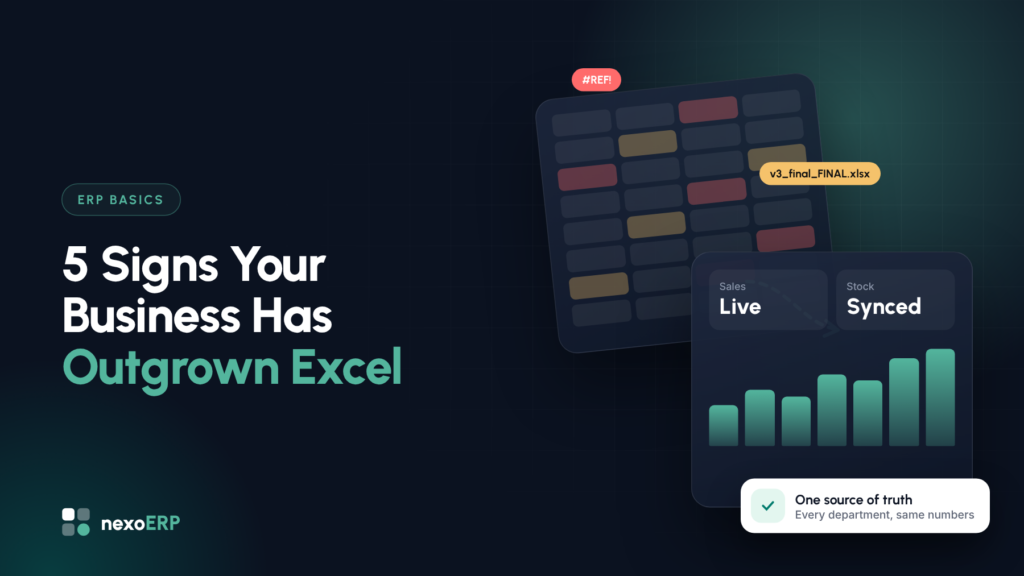
Almost every business starts on spreadsheets. They are free, flexible and everyone knows how to use them. But as orders, stock and staff grow, the same spreadsheets that helped you start can slowly hold you back.
Here are five clear signs your business has outgrown Excel.
1. Your numbers never match
Sales has one figure, accounts has another and the store has a third. When every department keeps its own sheet, nobody is working from the same data and every meeting starts with “which number is correct?”
2. Month-end takes days, not hours
If closing the month means collecting files from different people, copying rows and fixing formulas, you are spending your best people’s time on data entry instead of decisions.
3. You find out about problems too late
Low stock, overdue payments and delayed orders should be visible the moment they happen. In spreadsheets, they usually show up only when a customer complains or production stops.
4. One person “owns” the file
When only one person understands how the main sheet works, your business depends on them being available. If they are on leave — or leave the company — the knowledge leaves with them.
5. Mistakes are becoming expensive
A wrong formula, a deleted row or an old version of a file can lead to wrong quotations, wrong stock orders or wrong salaries. Small errors add up quickly at scale.
What’s the alternative?
An ERP system brings sales, purchasing, stock, production, accounts and HR into one place. Data is entered once and flows everywhere it is needed, reports are live, and alerts reach the right person at the right time.
If two or more of these signs sound familiar, it may be the right time to talk about a system built around the way your business works. Book a free demo and we will show you what that looks like for your business.